Gender Research in Natural Resource Management by Malika Abdelali-Martini Aden Aw-Hassan
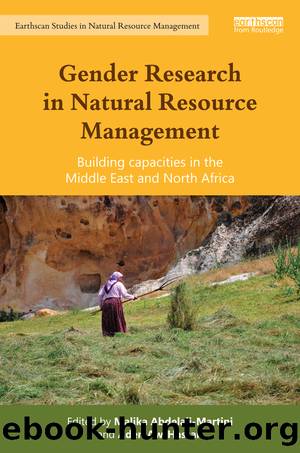
Author:Malika Abdelali-Martini, Aden Aw-Hassan [Malika Abdelali-Martini, Aden Aw-Hassan]
Language: eng
Format: epub
ISBN: 9780367173357
Barnesnoble:
Publisher: Taylor & Francis
Published: 2019-01-17T00:00:00+00:00
Participants identified first all the areas of change in the village. Then, votes were taken to determine two priority problems. For each problem we tried to fill all the columns of the table. During the discussions of the causes, the events that had preceded these causes were identified in chronological order, and the groups discussed how those finally led to the current situation.
Village resource map
This tool was used to help identify the physical as well as social context of the community in order to characterize the local climate conditions and risks. In each category of villages, focus groups of men and women were formed and we conversed separately with them. Here the starting point was created by drawing our point of reference on the map, which was usually the school or the mosque where our meeting was taking place in. Then we asked the participants to draw other facilities and resources that they also considered important in the village. The participants were encouraged to work on their own with minimal interventions of the facilitators, which allowed free discussion among villagers. The facilitators only interfered when they needed some clarification, as for example if the water source was a private property as opposed to a common one, or to stir the discussion forward.
The water map was drawn and all the wells and springs inside the commune were identified and mapped for each village representing one of the five groups. The distance from settlements to the main source was estimated and the workload and time spent to collect water was roughly averaged for the whole groups of villages. We also assessed the water quality and availability. Finally, we used Socioeconomic and Gender Analysis (SEAGA) questions to deepen the reflection on the social and economic uses of water, and the distribution of the roles and responsibilities of both male and female users in the community.
Seasonal calendar
This tool was used to describe the farmersâ perceptions of seasonal climate parameters such as typical rainfall amounts and timing as well as average seasonal temperatures over the last years and until the present time. For this tool, male and female participants were met separately in focus groups, and were asked to discuss the activities they do throughout the entire year. In separated focus groups of men and women, we explained to the participants that we want to learn about what they do throughout the year. On a large paper, we began by drawing a line at the bottom and a parallel line at the top. This line was divided into 12 compartments each containing one month of the year.
We began by asking questions on the agricultural work, then on the waged work, then on the availability of the water and finally on the availability of time. Women were requested to add their reproductive work. For each treated theme, participants had to give the work one of three marks: one â weak intensity, two âaverage intensity or three â high intensity. Participants were invited to discuss the activities
Download
This site does not store any files on its server. We only index and link to content provided by other sites. Please contact the content providers to delete copyright contents if any and email us, we'll remove relevant links or contents immediately.
| Anthropology | Archaeology |
| Philosophy | Politics & Government |
| Social Sciences | Sociology |
| Women's Studies |
Cecilia; Or, Memoirs of an Heiress — Volume 1 by Fanny Burney(32561)
The Great Music City by Andrea Baker(32021)
Cecilia; Or, Memoirs of an Heiress — Volume 2 by Fanny Burney(31958)
Cecilia; Or, Memoirs of an Heiress — Volume 3 by Fanny Burney(31944)
We're Going to Need More Wine by Gabrielle Union(19050)
All the Missing Girls by Megan Miranda(16038)
Pimp by Iceberg Slim(14515)
For the Love of Europe by Rick Steves(14149)
Bombshells: Glamour Girls of a Lifetime by Sullivan Steve(14078)
Talking to Strangers by Malcolm Gladwell(13375)
Norse Mythology by Gaiman Neil(13372)
Fifty Shades Freed by E L James(13245)
Mindhunter: Inside the FBI's Elite Serial Crime Unit by John E. Douglas & Mark Olshaker(9346)
Crazy Rich Asians by Kevin Kwan(9295)
The Lost Art of Listening by Michael P. Nichols(7507)
Enlightenment Now: The Case for Reason, Science, Humanism, and Progress by Steven Pinker(7315)
The Four Agreements by Don Miguel Ruiz(6767)
Bad Blood by John Carreyrou(6625)
Weapons of Math Destruction by Cathy O'Neil(6283)
